
Criminal Court Records in Canadian County
A Canadian County criminal court record is the case file the Court Clerk opens once the State of Oklahoma files charges. It is a running register of every event in a Canadian County criminal case, from the first information to the final judgment and sentence. The elected Canadian County Court Clerk keeps these files for the District Court, and the criminal division logs each docket entry as it lands.
Felony and misdemeanor cases both run through the Canadian County District Court. Felony files carry a CF prefix and misdemeanor files a CM prefix on the Canadian County docket. City code matters are different. A ticket from El Reno, Yukon, or Mustang stays in that city's municipal court and will not appear in the District Court file. For the charges themselves, the Canadian County arrest records and court charges page goes deeper, and the broader Canadian County court records page covers every case type the clerk keeps.
How to Search Canadian County Criminal Court Records
Two free portals carry Canadian County criminal court records and other Oklahoma dockets. The Oklahoma State Courts Network, or OSCN, hosts docket search for the state judiciary. On Demand Court Records, or ODCR, hosts records for participating courts and searches by name, case number, or filed date at no charge. Either is a fair first stop for a Canadian County criminal case.
- Open the OSCN docket search and click Court Dockets at the top of the home page.
- Enter a known case number, or search the defendant's name, then set the county to Canadian County.
- Narrow the results by court, case type, and filing date so the right Canadian County file rises to the top.
- Open the case to read the docket entries, the plea, and the disposition line by line.
- Request a certified copy from the Court Clerk when a file-stamped record is needed for a legal use.
The ODCR search works the same way and takes partial names. When the case number is unknown, the Canadian County Court Clerk record search page offers a mail option with a $5.00 fee and a stamped return envelope, and the clerk does not search by phone. After a prison sentence, the Oklahoma DOC offender lookup tracks custody status, though it is abbreviated and is not the court file.
Note: OSCN states its online case search is a public convenience, and where the data conflicts the court relies on its own case management record.
Stages of a Canadian County Criminal Case
A Canadian County criminal case moves through set steps, and each step leaves a mark in the record. Reading the Canadian County docket in order is the clearest way to see where a case stands. The flow below traces the path from the charging document to the sentence.
Case flow: Charges Filed › Arraignment › Pretrial / Motions › Plea or Trial › Disposition › Sentencing
Charges begin with an information filed by the District Attorney or, in some cases, a grand jury indictment under Title 22 of the Oklahoma Statutes. From there a Canadian County file grows with each hearing, bond entry, and order. The table shows what each main stage adds.
| Stage | What Happens |
|---|---|
| Arraignment | The first formal appearance. The court reads the charge, sets or reviews bond, and the defendant enters an early plea. The Canadian County docket logs the date and the bond terms. |
| Pretrial / Motions | Lawyers file motions, exchange evidence, and argue legal points. Continuances, rulings, and a Rule 8 cost hearing may appear in this window. |
| Plea or Trial | The case ends in a plea, or it goes to a judge or jury. A guilty, not guilty, or no contest plea is recorded, or a verdict is returned. |
| Sentencing | The court enters the judgment and sentence, fixes fines and costs, and sets any probation terms. This line is the heart of the disposition. |
What a Canadian County Criminal Court Record Shows
The public docket pulls the people, the charges, and the outcome of a Canadian County criminal case into one place. Some fields fill the day the case opens. Others fill as it moves. Online systems often show docket text without the pleadings, so a full Canadian County record copy may still need a clerk request. The table maps the core fields to what each one tells you.
| Field | What It Shows |
|---|---|
| Case Number | The court's file number, with a prefix that marks the type. CF means felony and CM means misdemeanor in Canadian County District Court. |
| Defendant | The person charged. The State of Oklahoma is the other party, since the District Attorney brings the Canadian County case for the public. |
| Charges | The offense text, the statute cited, the degree, and each count. A case can carry more than one count. |
| Plea | The defendant's answer to the charge. Common entries are guilty, not guilty, and no contest. |
| Disposition | The current or final outcome of each count, such as convicted, dismissed, deferred, or acquitted. |
| Sentence | The punishment imposed, including jail or prison time, probation, fines, costs, and restitution. |
Note: docket entries can also list the judge, the attorneys, hearing dates, bond amounts, warrant events, and the cost or payment plan tied to a Canadian County case.
Who Prosecutes Canadian County Criminal Cases
Criminal cases are brought by the State, not by a private person. The District Attorney for Oklahoma District 4 prosecutes felonies and misdemeanors in Canadian County. District Attorney Tommy Humphries leads District 4, which also covers Blaine, Garfield, Kingfisher, and Grant counties. The DA decides what to file, by information or by grand jury indictment, and that charging choice is set in Title 22 before a Canadian County case opens.
The state and county roles can confuse, and official pages sort them out. The Oklahoma District Attorneys Council District 4 page lists the prosecutor and the Canadian County office contacts.
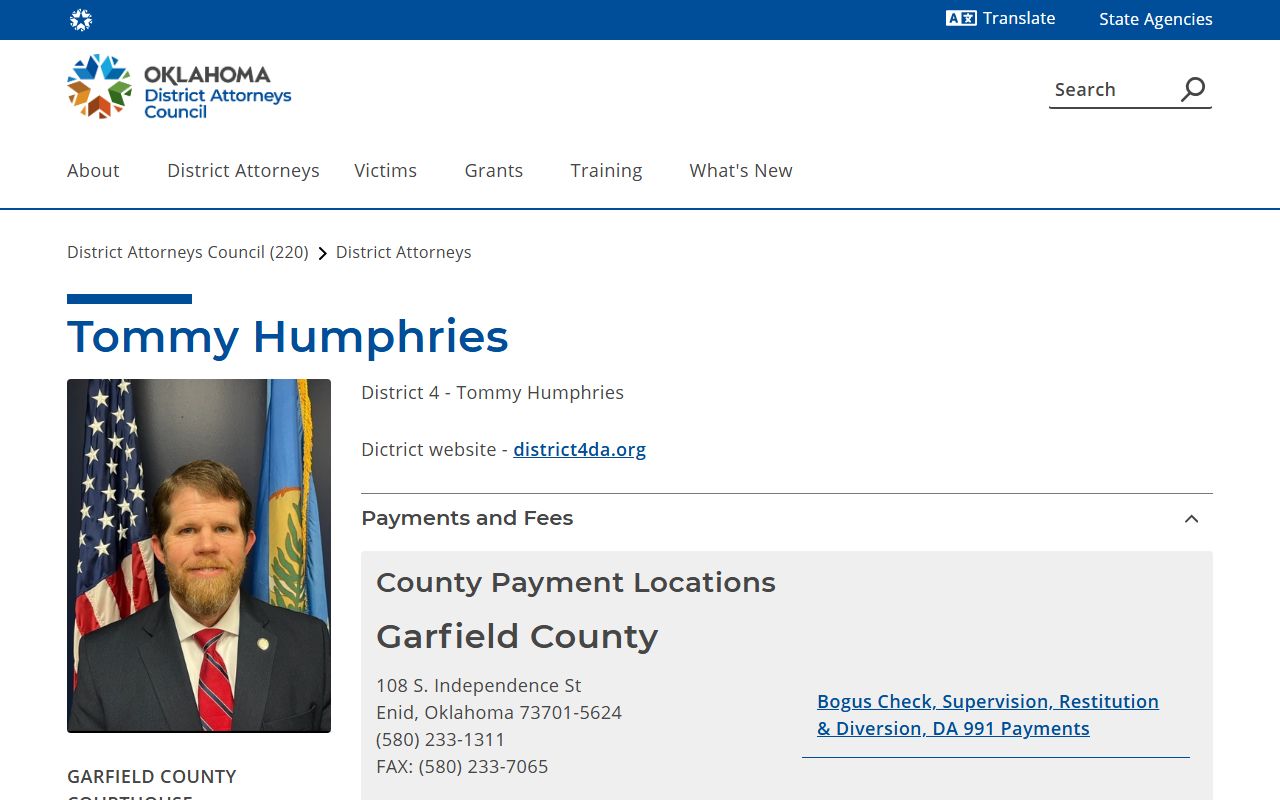
That page ties the state structure to the local office that files charges in a Canadian County criminal court record. The District 4 office also runs its own site, shown on the District 4 District Attorney home page.
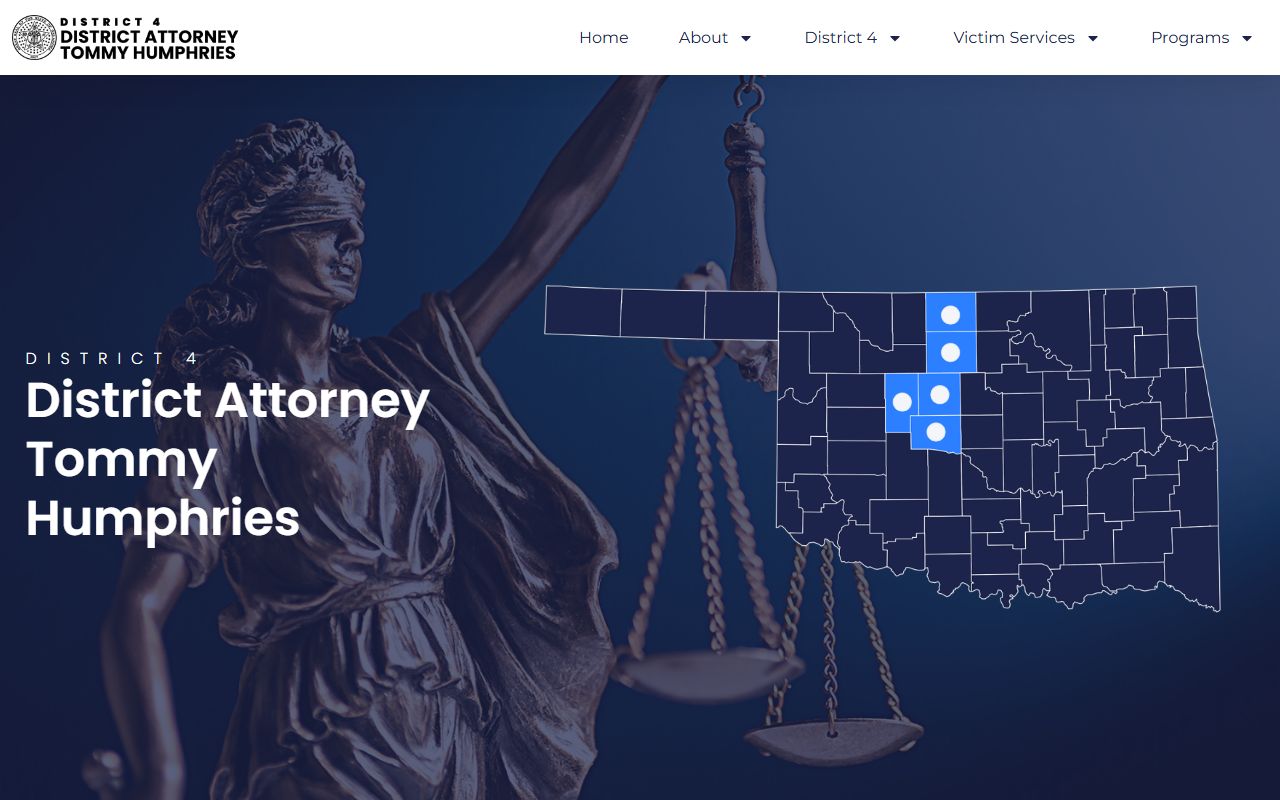
The home page links into each county served. The Canadian County DA courthouse office sits at 303 N Choctaw in El Reno, phone (405) 262-0177, open Monday through Friday, 8:00 a.m. to 5:00 p.m. for Canadian County matters.
Victim Services in Criminal Cases
Victims and witnesses often need court dates, restitution updates, and hearing notices that a Canadian County docket does not spell out. District 4 runs a victim services program for that, and the Canadian County District Attorney page lists the courthouse and Children's Justice Center offices.
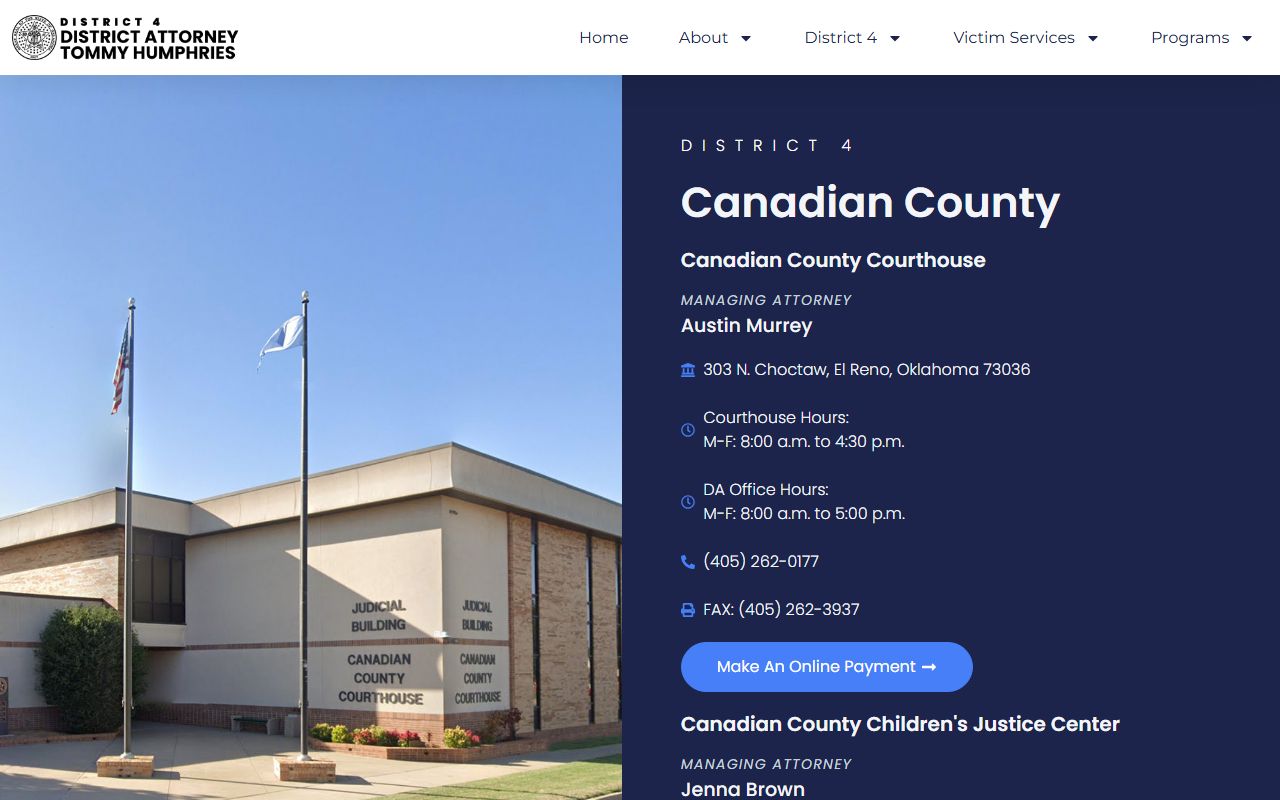
That county page is the quickest route to the local Canadian County DA contacts behind a criminal court record.
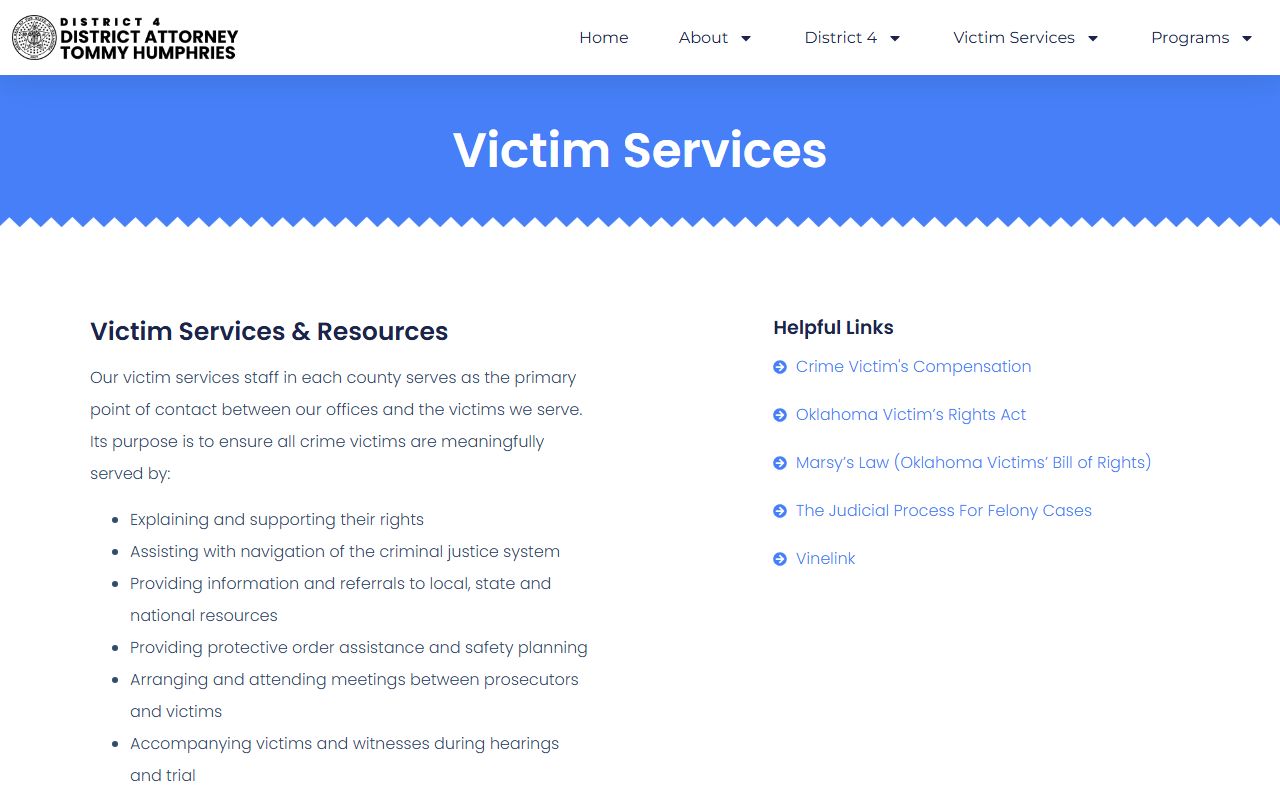
The District 4 victim services page lists the Canadian County courthouse and Children's Justice Center offices as resources, and the county directory names a Victim Witness Coordinator at (405) 262-0177 for Canadian County cases.
Appointed Counsel in Canadian County Criminal Cases
A defendant who cannot afford a lawyer may qualify for appointed counsel, decided by the court after an eligibility review. The Canadian County Criminal Department uses an Application and Order for Appointed Counsel and an Affidavit Regarding Ability to Pay, and both forms appear in the Canadian County criminal workflow.
The Oklahoma Indigent Defense System, known as OIDS, provides indigent defense in covered areas of the state. The Oklahoma Indigent Defense System page sets out the agency and how it serves court-appointed clients.
OIDS staff handle many Canadian County defense assignments once the judge appoints counsel, so the agency is the backstop a Canadian County criminal court record points to for an indigent defendant. Counsel is appointed through the court after the indigency forms are reviewed, not requested as a public records office.
Paying Canadian County Criminal Court Costs
Most Canadian County criminal cases end with fines, court costs, and sometimes restitution. The Court Clerk Cost Administration Department handles these payments inside the Judicial Building at 301 N Choctaw in El Reno. Canadian County criminal cost payments are taken Monday through Friday until 4:00 p.m., and the counter is first come, first served with no appointments.
Payment options include money order, cashier's check, and major cards, and the cardholder must be present for in-person card payments, though phone card payments are now accepted. A payout plan is not automatic; a Canadian County defendant must appear in Cost Administration as ordered. Bonds follow a stricter rule.
- Cash-only bonds must be paid in cash, with no cashier's checks, money orders, or cards.
- A cash-only bond must be posted before 3:30 p.m.
- Fines and costs are generally due the day of sentencing unless a payout option is approved.
- Criminal forms, including the appointed-counsel application, are returned to the clerk in blue or black ink only.
The Canadian County criminal department page sets out the cost location, the payment methods, and the cash-bond rule in full.
Charges vs. Convictions
A charge is an accusation. A conviction is a finding of guilt. A Canadian County criminal court record can show charges that were later dropped, dismissed, or that ended in an acquittal, so reading the charge line alone can mislead. The disposition line tells you whether a charge became a conviction. Read the two together.
| Charge | Conviction | |
|---|---|---|
| Stage | Accusation | Verdict or plea |
| Burden of Proof | Probable cause | Beyond reasonable doubt |
| Public Record | Yes | Yes |
Reading Dispositions and Sentences
The disposition is the outcome of each count on a Canadian County criminal record. Common entries are guilty, not guilty, dismissed, and no contest, shown as nolo contendere. Oklahoma also uses a deferred sentence, where the court holds off on judgment while the defendant meets set conditions. A deferred sentence that ends well can be updated to show the case dismissed, which is not a clean expungement.
The sentence line follows. It can list jail or prison time, probation, fines, costs, and restitution. Probation is community supervision, while parole is supervised release after prison. A suspended sentence holds part of the term back while the defendant follows the rules. These terms appear in plain order on a Canadian County judgment and sentence.
Sealed vs. Expunged Criminal Records
Sealing and expungement both limit public access to a Canadian County criminal record, but they are not equal in Oklahoma. The Oklahoma State Bureau of Investigation, or OSBI, draws a clear line between the two main expungement paths. A Section 18 expungement under Title 22 can seal an entire arrest record when the person fits a statutory category. A Section 991(c) expungement is narrower.
Under 991(c), a person who completed a deferred sentence can have the plea and disposition updated to show "pled not guilty, case dismissed." That change does not remove the arrest record. Only a Section 18 expungement reaches the broader arrest file. The table sets the two Canadian County outcomes side by side.
| Sealed | Expunged | |
|---|---|---|
| Visibility | Hidden from public view | Removed from public access under the order |
| Law Enforcement | Limited access | Very limited access |
| Eligibility | 991(c) deferred-sentence dismissal updates the disposition but keeps the arrest record | Section 18 can seal the full arrest record when the statutory category is met |
An expungement begins in the court with jurisdiction over the case, usually the Canadian County District Court. After the order is granted, it must reach OSBI and other repositories. The OSBI expungement guidance explains both paths in plain terms. Canadian County Court Clerk fees for expungement were not posted in the county sources, so ask the clerk before filing.
Public Access to Canadian County Criminal Records
Most Canadian County criminal case files are open to the public. Oklahoma treats court records as public unless a statute or court rule makes them confidential. That framework is what lets anyone read a Canadian County criminal docket online or at the clerk's counter. A few statutes set the boundaries.
Key Statutes:
Oklahoma Statutes Title 51 § 24A.5 - the Open Records Act opens public-body records for inspection and copying during business hours unless a law makes them confidential.
Oklahoma Statutes Title 22 - sets criminal procedure, including prosecution by information or by grand jury indictment.
Court of Criminal Appeals Rule 2.6 - OSCN provides a public online case search, but the court's case management record controls if the data conflicts.
Background Check Considerations
A casual docket lookup and a formal background check are not the same. An employer, landlord, or lender who screens for hiring, housing, or credit must follow the federal Fair Credit Reporting Act through a regulated consumer reporting agency. A free OSCN or ODCR search of Canadian County criminal records is fine for personal knowledge, but it is not a compliant background report on a Canadian County case and can be out of date.
Important: This website is not a consumer reporting agency under the Fair Credit Reporting Act, and its records may not be used for employment, tenant, credit, or insurance screening decisions.
Restricted Canadian County Criminal Records
Not every Canadian County criminal record is open. Juvenile cases are confidential under Title 10A of the Oklahoma Statutes and are not open to the general public except as the law allows. Sealed and expunged files drop from public view by court order. Adoption and mental health matters follow their own rules, and identifiers such as Social Security numbers, account numbers, and protected addresses are redacted on public Canadian County records.
The Title 10A Children and Juvenile Code sets the juvenile confidentiality rule. For sealed, expunged, juvenile, or otherwise restricted files, expect no public access without party status, attorney authority, or a court order. When a Canadian County question reaches past the case file to an active warrant, the county warrant records page covers what to do next.