
What Probate Covers in Canadian County
Probate is the court process for handling a person's estate after they die. In Canadian County, that work belongs to the District Court. The county has no separate surrogate, orphans, or stand-alone probate court. Instead, probate runs as a docket of the Canadian County District Court, and the case file sits with the Court Clerk's Probate Department at the El Reno courthouse. A probate case can open with a will or without one. It covers proving the will, naming someone to manage the estate, paying valid debts, and passing what is left to heirs or named beneficiaries.
The court's authority comes from state law. Under Title 58 of the Oklahoma Statutes, the District Court holds probate jurisdiction over wills and estates. That power covers opening and receiving proof of wills, admitting or revoking probate, recording foreign wills, and granting letters testamentary, letters of administration, and letters of guardianship. Judicial determination of death and guardianship matters move through the same probate docket. Because all of it stays in the District Court, Canadian County probate records are searched the same way as other district court cases.
Probate Terms Defined
Probate filings use words that rarely come up in daily life. A short glossary helps when reading a Canadian County probate file or talking with the Court Clerk.
- Testator
- The person who made the will. When that person dies, the will is offered to the court for proof.
- Executor
- The person named in the will to carry it out, gather assets, pay debts, and distribute what remains.
- Intestate
- Dying without a valid will. The estate then passes under Oklahoma's rules for heirs rather than by a will.
- Guardianship
- A court order giving one person legal authority to care for a minor or an adult who cannot manage their own affairs.
- Conservatorship
- A court arrangement to manage the property and finances of a person who is unable to do so alone.
How to Search Canadian County Probate Records
Two free statewide tools index Canadian County probate cases. The Oklahoma State Courts Network (OSCN) and On Demand Court Records (ODCR) both let the public search district court dockets. Search by the decedent's name, by a party name, or by the PB case number that probate cases usually carry. On OSCN, open Court Dockets, set the county to Canadian County, then enter a known case number and go. ODCR adds partial name searches, case-number searches, and filed-date range searches across participating courts.
When a Canadian County case is older, sealed, or simply does not surface online, the Court Clerk record search is the fallback. Each channel works a little differently.
- Online: search OSCN or ODCR by decedent or party name, or by a PB case number.
- In person: visit the Court Clerk counter at 301 N Choctaw Avenue in El Reno.
- By mail: send a written request with as much case and party detail as possible.
- Mail search fee: $5 when the case number is unknown, paid by check or money order, with a self-addressed stamped envelope.
- By phone: not offered, since the Court Clerk does not run record searches over the phone.
Note: OSCN and ODCR are convenient public portals, but the District Court's case-management record controls if the online data and the official file ever disagree.
Canadian County Probate Filing Fees
The Court Clerk's Probate Department posts set fees for the most common estate and guardianship matters. The amounts below cover the filings handled through the probate docket of the Canadian County District Court, plus the mail search fee charged when a requester does not know the case number.
| Filing or service | Amount |
|---|---|
| Probate of estate | $207.89 |
| Judicial determination of death | $212.89 |
| Relative guardianship | $77.00 |
| Non-relative guardianship | $201.64 |
| Mail record search (case number unknown) | $5.00 |
The county's official Probate Department page lists these probate costs and explains how estate filings are handled.
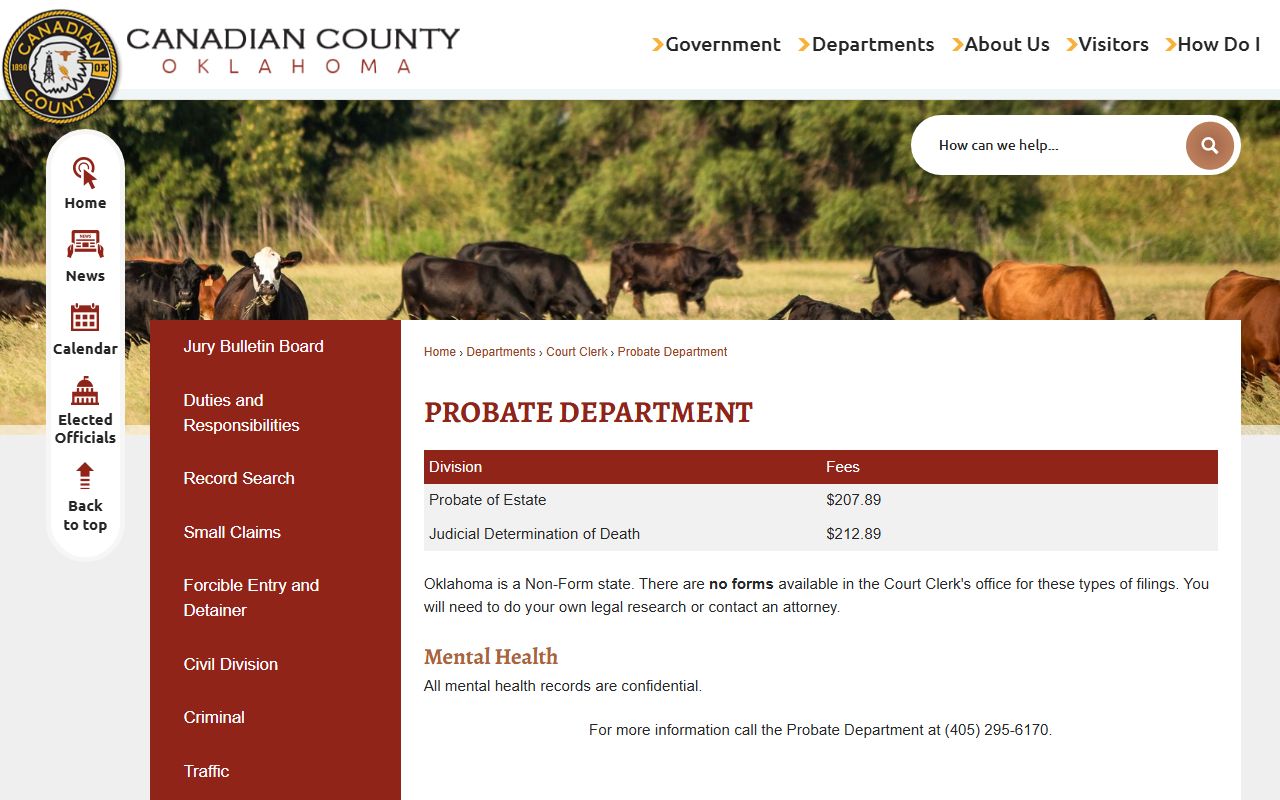
Checking that page first is the fastest way to confirm current Canadian County probate fees before mailing a request or filing in person.
How Probate Works in Canadian County
An estate case in Canadian County moves through clear stages, though the paperwork is the filer's responsibility from the start. The steps below outline the usual path from opening a case to closing it.
Important: Oklahoma is a non-form state. The Canadian County Court Clerk does not provide probate forms for these filings, so a self-represented filer must prepare the pleadings through legal research or hire an attorney.
- Decide whether a probate, a judicial determination of death, a guardianship, or another proceeding fits the situation.
- Prepare the pleadings through legal research or an attorney, since the Court Clerk supplies no probate forms.
- File with the Court Clerk and pay the fee, $207.89 for probate of an estate or $212.89 for a judicial determination of death.
- Get the case number and hearing date, then give the required notices to heirs, devisees, creditors, and other interested persons.
- Attend the hearing and obtain the orders or letters that let the estate be administered.
- File the inventory, the accountings, and the final papers, then ask the court for the discharge or closing order.
Judicial Determination of Death
Not every estate needs a full probate. When the main goal is a court ruling that a person has died and a finding of who the heirs are, Oklahoma allows a judicial determination of death. This route often fits when property must pass but a long, formal estate administration is not needed.
In Canadian County the filing fee for this proceeding is $212.89, a little higher than the $207.89 charged for a standard probate of estate. The case still runs through the Canadian County District Court probate docket, and the file still stays with the Court Clerk. As with any estate matter, the filer prepares the pleadings, because no county forms are supplied.
Guardianship Records in Canadian County
Guardianship cases share the probate docket. A guardianship gives one person legal authority to care for another who cannot manage their own affairs, such as a minor or an incapacitated adult. The Court Clerk lists two filing levels: $77 for a relative guardianship and $201.64 for a non-relative guardianship. Guardianship files can hold petitions, background checks, medical reports, notices, the order appointing a guardian, annual reports, and protected personal details.
One local rule trips up many filers. The county's Guardianship page states that a person cannot file a guardianship on their own child unless the other parent is deceased. That limit surprises parents who expect to use a guardianship to settle custody, so it is worth confirming the right proceeding before paying a fee.
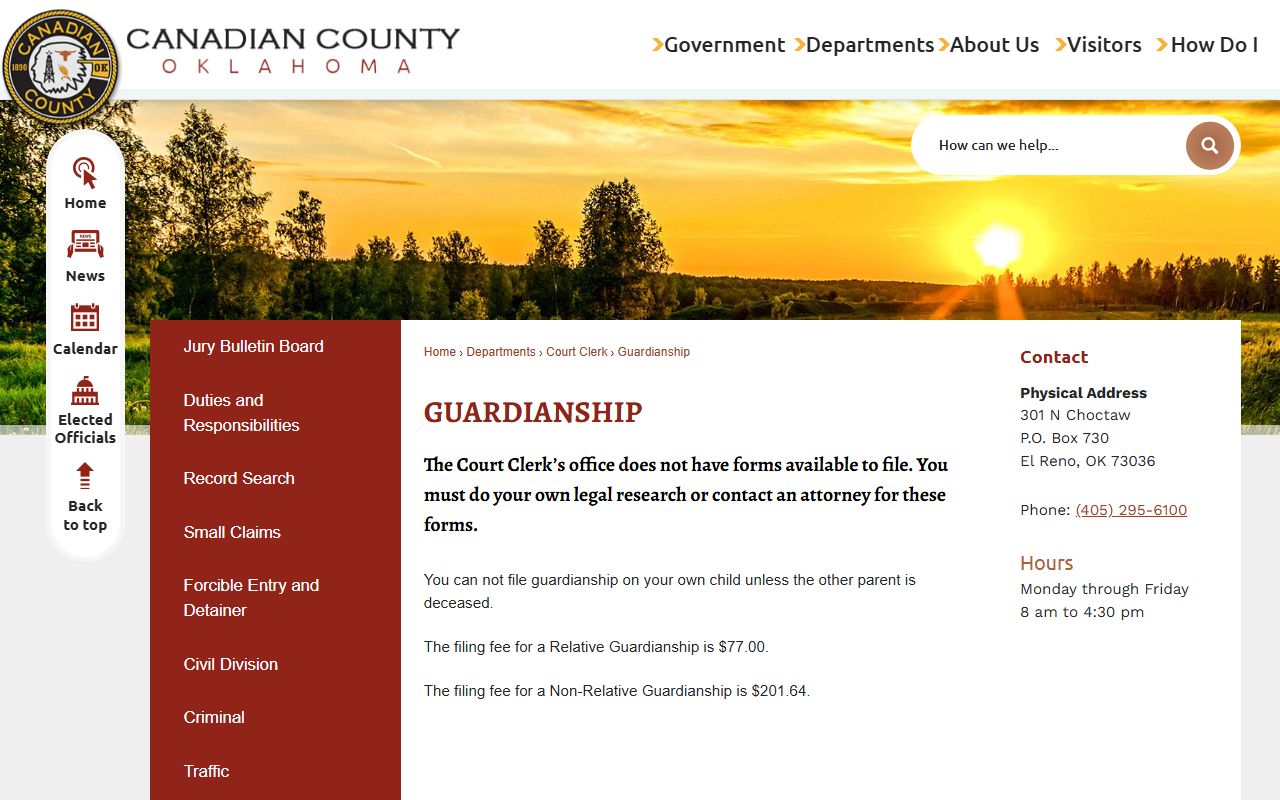
The page also breaks down the relative and non-relative fee levels, which helps a filer budget before the case opens.
What Canadian County Probate Records Show
A probate file grows as the case moves. Early filings open the estate and name a personal representative. Later filings track the assets, the debts, and the final split of property. A complete Canadian County probate record can include several distinct documents, and the Canadian County District Court keeps each one in the case file.
- The will, if one exists, along with the order admitting or denying it to probate.
- Letters testamentary or letters of administration that authorize the estate manager.
- An inventory and appraisement of the estate's property.
- Notices to creditors and to heirs, plus any claims filed against the estate.
- Orders to sell property, accountings, and the final plan of distribution.
- The discharge or closing order, and any contested will or heirship disputes.
Online dockets usually show these events as text entries. Full document images are not guaranteed, so a certified copy may call for a mail or in-person request to the Court Clerk.
Restricted Canadian County Probate Records
Most probate dockets are open to the public, but parts of a file are shielded. Public versions redact Social Security numbers, financial account numbers, protected addresses, and details about minors. A guardianship that involves a child draws extra protection, and any juvenile matter tied to a Canadian County probate case is handled with care.
Under Title 10A of the Oklahoma Statutes, juvenile and protective-custody records are confidential and not open to the general public except as the law allows. The state's juvenile agency explains the same rule in plain language.
The Oklahoma Office of Juvenile Affairs frequently asked questions page quotes the confidentiality language that keeps these records out of public view.
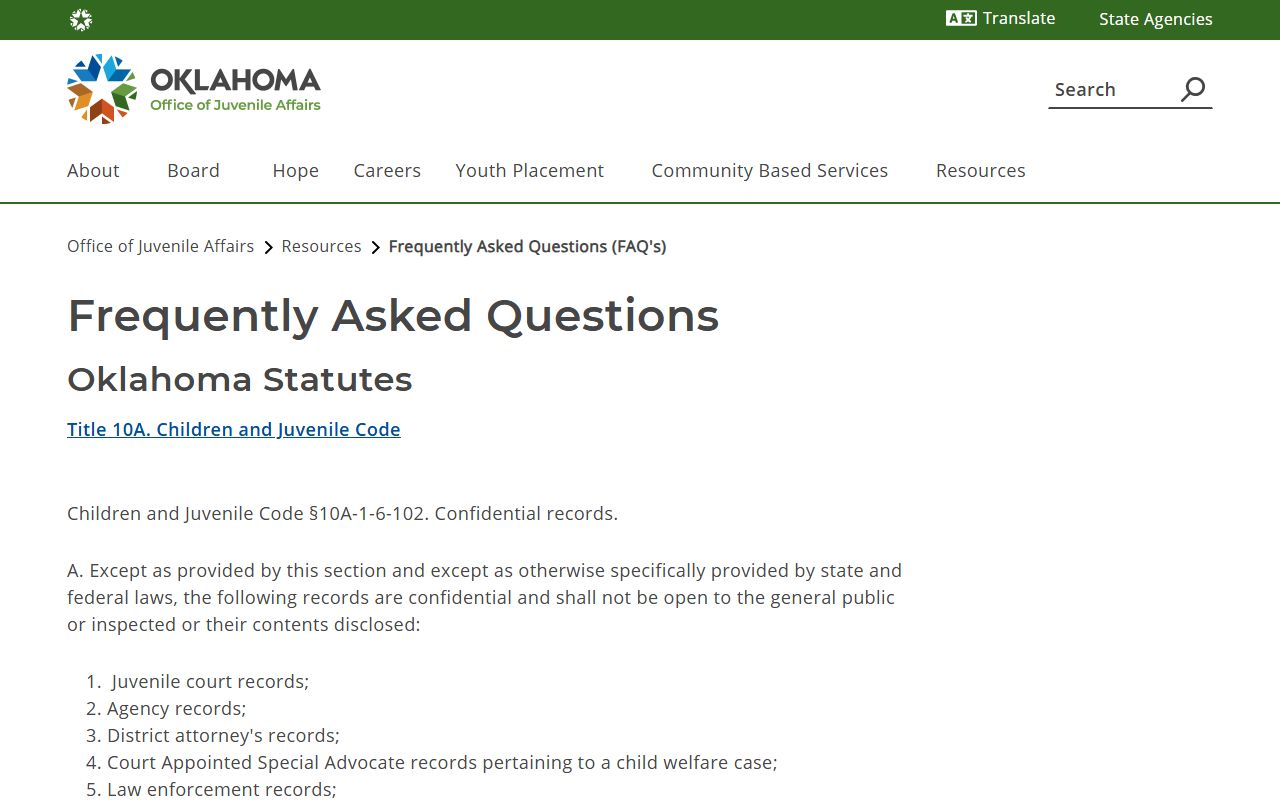
That guidance matters for guardianship files, where a minor's information sits next to public estate data and must stay protected.
Note: When a record is sealed or involves a minor, expect no public access without party status, attorney authority, or a court order from the District Court.
Canadian County Probate Department Office
The Probate Department sits inside the Court Clerk's office at the El Reno courthouse. Filings, fee payments, and in-person record requests for Canadian County probate records all run through this counter during posted hours.
Court Clerk Probate Department
Canadian County Court Clerk
301 N Choctaw Avenue
P.O. Box 730
El Reno, OK 73036
(405) 295-6100
Mon-Fri 8:00 a.m.-4:30 p.m.
County Clerk Land Records Crossover
Probate often touches real estate, and that pulls in a second Canadian County office. The Court Clerk keeps the probate case file, but recorded deeds, probate-related conveyances, and liens are filed with the Canadian County County Clerk. After an estate transfers a home or a parcel, the new deed is recorded in the land records, not the probate docket.
So a full picture of an estate may need both offices. Use the probate docket for the case events, the orders, and the letters. Use the land records for the recorded instruments that show how title actually moved. Family matters tied to an estate, such as a spouse's prior divorce decree, can also affect who inherits, and those files stay with the Court Clerk as well.